Can writing mindfully be more healing than writing expressively?

I’ve always believed that writing down feelings is a route to healing them. For me, as a writer, the mere action of putting fingers to keyboard and letting my soul spill out onto the screen is healing in itself.

Write mindfully about everyday happenings can help divorced people face their feelings. (pic:istockphoto.com/nameinframe)

But that’s not the case for everyone – especially people going through recent separation or divorce. Or so says this fascinating report from Huffington Post on a scientific study into the different kinds of writing therapy that can have different kinds of emotional effects.

Researchers asked one group to write about their anger, guilt and all the other feelings that come up post-divorce. A second group wrote their story with a beginning, middle and an end, like a novel. And a third group merely wrote down what they did during the day (went shopping, sent emails etc). The groups were also categorised into people who brood over things and people who seek meaning from their trauma.

The outcome of the experiment wasn’t at all what scientists were expecting, however. The feeling writers and story writers fared worse emotionally than the people cataloguing their daily deeds – suggesting that brooding on your feelings when they’re raw really doesn’t help separated people feel any better.

I’m surprised and fascinated by the article’s conclusion. Author Wray Herbert says: “Writing about boring and ordinary stuff helps divorcing men and women to re-engage in their daily lives without focusing on emotional pain and loss. Thinking about lunch and laundry may distract brooders from their brooding.”

So there we have it. Being mindful of the boring stuff in the moment is what can really help.

How many signs does the Ego need to surrender to the Soul’s wisdom?

OK. So you’re on the verge. Of surrendering all the coping mechanisms you’ve ever relied on. [Full stop after ‘verge’ is significant.] All the stuff and guff of your environment – your behaviour and all the interpersonal relationships that you believe define you – are clinging on for dear life. And about to lose their stranglehold grip.

Except they don’t. At least not just yet. They’ve just been there to defend you. They think they’re saving you. But really they’re strangling you.

Having a life crisis, where you feel the entire planet is conspiring against you, is really an opportunity for you to realise this. The crisis creats porous entry points in your psyche for your real stuff to sneak in. Often before you’re ready for it. To catch you out. It has to create the opportunities it can, because you’ve been denying and dancing around the truth for decades. Tough, huh?

However, it can take some time to tune into what those signs are. They may have to really poke you in the nose before you spot them. Some people spend a lifetime oblivious to them. But there’s something about being able to spot the signs nudging you soul.

Here are three of mine from today: Continue reading

When I need strength, where do I look…?

This has been a big issue for me this week. I’ve been going through an issue that requires some practical, emotional and psychological strength, and I’ve been wondering how on earth I can get through it.

I’ve been looking outside of myself for quotes, for expertise, for some kind of reassurance that I’ll be OK. That I’ll get through this test and everything else will be OK.

Except anyone on a spiritual journey knows that, once one task has been brought to consciousness and integrated, another more testing one awaits. That’s the nature of personal growth. The universe may not give us anything we’re not able to deal with, but by heck, once you’re able to deal with one area of consciousness, the universe will of course chuck you a new challenge.

Which brings me back to how I’m going to deal with my issue. I’ve done everything I can to influence the outcome I want, but ultimately the outcome is in the hands of another mortal being (complete with biases, prejudices etc).

And so I am aiming to reach some kind of peace. Tomorrow will bring its own resolution. I am seeking balance, not retribution. I may get some kind of equilibrium, but I so hope the fight will stop and I will be able to continue to be a balanced, hopeful person rather than a defended, anxious one.

In the meantime, I am finding inner strength I never knew I had. For all of the quotes I found, this is the one that always sustains me, and it’s my yoga teacher’s version of the Emerson quote: “The power within you is always greater than the task ahead.”

That is where I get my strength from.

If creativity helps you live longer, let’s give more freedom to our inner child

I do love psychological research that tells us how to live longer – especially if one of those behaviours or qualities is what I do already. So I was delighted to read on Psychology Today a report on a study that has evidence to show that being creative can help you live longer. (Well, at least among men, anyway).

Basically, the study of 1,349 men over 18 years shows that being open to new ideas and being willing to try new things can lengthen your lifespan, with a 12% reduction in mortality risk.

How does creativity help? It basically exercises the brain to keep it fit and it helps to reduce stress levels (or at least helps to manage stress better and make it less daunting). Creativity is recommended throughout the whole of life to cope better with the onset of aging, and our thoughts and feelings around it. (Who doesn’t feel better after having externalised our stresses through painting, writing or even dancing).

When you see kids playing with paints, being clever with crayons, and lacking any kind of self-consciousness when they sing, dance and play, I often wonder where that innocent sense of playfulness and creativity goes when we grow up.

Let’s bring our inner children out more often and let them have a play. I think that the creativity the researchers talk about is also related to a sense of fun and a feeling that life is still full of wonder and curiosity, no matter what age you are.

The yin-yang of career: how to turn contradictory into complementary

If you’re in a career you’re meant to be single-minded. If you’re a therapist you’re meant to be caring. What’s the problem about combining them both?

I’ve struggled with years with people who compartmentalise their lives, splitting off their work persona from their private person. Split being the operative word. They are cut off from who they truly are.

Life has to be black or white. Grey is unpleasant, fuzzy and depressing. Extremes seem contradictory. Polarities seem impossible.

Except what if you get your meaning from opposing things, who is to challenge you otherwise. A boss of mind summed this up today as the business (writer/editor) side and the softer (therapist side) as providing the ideal yin/yang healthy combination of how people can and should operate.

Details aside, it’s nice to be open about one’s self, and be appreciated for it. And, instead of castigating the side of oneself that is perhaps out of step with the other, to perhaps for a second consider the beauty of the opposite. Instead of the ‘you’re wrong’ versus the ‘I’m right.” Think instead of the yin to the yang.

My soul’s lesson for today: what you do, you get more of (whether you want it or not)

On the train to work this morning, I wondered why the person who sat down opposite me needed to finish off eating his tube of mango ice cream (yes, at 8.30 in the morning!) with his fingers (yes, on a crowded train!) The sucking and slurping turned my stomach, and distracted me from a paper I was reading for my project.

Fast forward a couple of hours and I am sitting in a fairly quiet sandwich shop with my laptop, trying to work on said project, and a big bloke sits down beside me, chomps his tuna and cucumber wrap loudly, and licks his fingers with aplomb every time he takes a bite. I only wanted a quiet corner to work on some writing, not to be interrupted by other people’s noisy eating habits!

It’s so annoying to keep magnetising experiences in my life I’d rather do without. (pic: istockphoto.com/michelangelus)

Why have I attracted two annoying people with questionable manners to sit down near me and interrupt me? I can’t think of any reason why I magnetised the noisy eaters into my energy field, other than the fact that I have been delaying putting the finishing touches to my project. And these aural and visual assaults are a consequence of not having committed to my day. Distraction breeds more distraction.

I pressed the snooze button on my alarm one too many times this morning, and so I was late getting the train. I needed to read and take notes but couldn’t do that easily because I had to stand up all the way. Lateness breeds more lateness.

I had my mid-morning snack later than usual today, so I wasn’t hungry when I ordered my lunch. Today they gave me a huge portion that I couldn’t finish because I was still full from earlier. Fullness breeds more fullness.

I think the lesson my soul wants me to remember today is Continue reading

If printer ink costs more than vintage champagne, what does that say about my writing?

Today I discovered that printer ink, drop for drop, costs more than the finest champagne. This may not be news to many people, as the story came out nine years ago, but it’s a fascinating new fact for me.

It got me thinking of all kinds of metaphors about sparkling prose, effervescent poetry and vintage style all served chilled in the finest crystal flute. Writing, for me, can feel rather fizzy at times – when it flows, of course. And at other times it can fall rather flat.

However, I rather love the idea that ink on the page from my home printer is more valuable than the bottle of Bollinger on my wine rack.

It has certainly put a new value on my writing. And I’ll drink to that!

Am I the only writer for whom an MA achievement is an anticlimax?

I’ve been trying to put a name to the feeling that’s mine right now – and all of London’s. Not to big myself up, or minimise the impact of London 2012 and the phenomenal achievements of the Olympians and Paralympians. But there’s something in the air that I’ve been trying to feel, own, and put into words. Without sounding ungrateful. Or like a next-project-obsessed workaholic.

Even the best parties have to come to an end.

OK, so I may be both of those things. At times. But this feeling is like the puckered balloons the day after a mega party. The dust-covered peanuts you find down your sofa weeks after a dinner party. And the sense of having loved (all the guests) and then lost (when they all leave) when you’ve worked so hard and wanted to make every detail a winning, talked-about one. Which parties generally are, and they certainly were for the million people I had to say ‘excuse me’ to, on a way to a meeting through central London at lunchtime yesterday. A million people lined the streets to salute the London 2012 stars.

But my individual deflated feeling, in the midst of all this post-Olympic partying, started with the certificate arriving for my MA. Continue reading

Expressing your fears takes their power away

It’s something therapists and writers have known for years, but now psychologists have confirmed that naming your fears stops them having so much power over you.

Giving a name to something, or expressing exactly how you feel, means you don’t have to deny the feeling or keep squashing it down. Sometimes the energy needed to keep it at bay is more painful and stressful than just talking about it anyway. Writers use that technique all the time: expressive or reflexive writing puts into words their feelings and stresses, and therefore externalises what’s going on inside and helps to process feelings and look at them objectively.

Researchers from the University of California, Los Angeles (UCLA) did some tests on people who are afraid of spiders, asking some of them to approach a tarantula, and to experience and label their fears. For example, to say: “I’m anxious and frightened by the ugly, terrifying spider.” People who were able to express their fears were able to get closer to the tarantula, and had less of a stress reaction.

Michelle Craske, a professor of psychology at UCLA and the senior author of the study, said: “The implication is to encourage patients, as they are exposed to whatever they are fearful of, to label the emotional responses they are experiencing and label the characteristics of the stimuli — to verbalise their feelings. That lets people experience the very things they are afraid of and say: ‘I feel scared and I’m here.’ They’re not trying to push it away and say it’s not so bad.”

The crucial point is this: “Be in the moment and allow yourself to experience whatever you’re experiencing.”

Why do we only truly appreciate the BIG moments in life…?

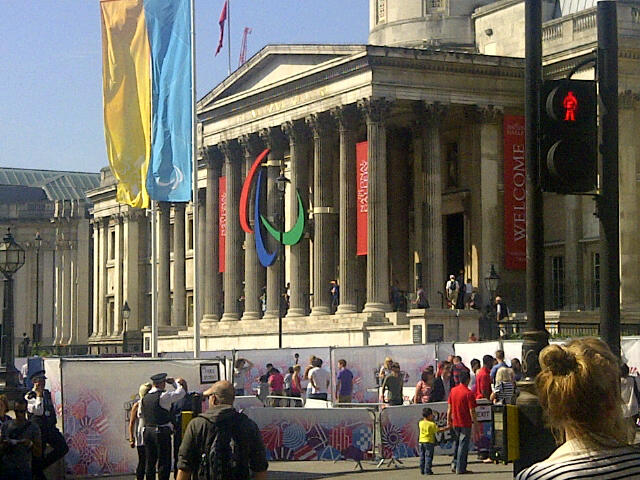
I attended the Paralympic Games this week. It was hard enough to get tickets to the Olympic Stadium, given the success of London 2012, and I was full of awe at just being there.

The Paralympics in London have been awesome on so many levels.

My eight-year-old daughter was beside herself with excitement: she’d been looking forward to it for weeks. She throws herself into whatever event, party or park she’s at, wholeheartedly and whole-bodily present. In comparison, I often find my mind wandering, and my body shifting to get comfortable. I envy her ability to truly live her moment.

Except at the Paralympic athletics this week, I lived mine. From the moment I entered the stadium – watching strong men in wheelchairs power across the finish line, one-legged men effortlessly clearing high jumps, and the whole crowd cheering for every other country’s anthems – I felt humbled to be human. Especially given the superhuman feats taking place in the stadium in front of me.

It was a hot evening, but a friendly and uplifting one. I breathed in each moment I was there, knowing there wouldn’t be any others like this. I didn’t want the lights to come on, because I knew that would signal home time.

I truly lived my BIG moment because I knew my chance to watch Paralympic athletics at the London 2012 Olympic stadium would never come again. So why don’t I appreciate all moments in the same way – big, small or otherwise – even though I know they won’t be repeated either…?